
What is independence? Ukraine’s long fight for autonomy.
From the Ukrainian People’s Republic in 1917 to Russia’s full-scale invasion, Ukraine’s struggle for independence has been shaped by repression, resistance and the defence of its right to self-determination. Writing from a Scottish perspective, this blog explores how Ukraine’s history has shaped a different understanding of what independence means to me and why Ukrainians continue to defend it today.

Grace Maclean
Intern
What did I think independence meant?
Growing up Scottish, I had a specific understanding of what independence was and how I perceived it. To me, independence was constantly discussed, argued, agreed upon (often disagreed upon), and was a key part of Scottish political life and a formative part of individual and party politics.
Yet, the more I have learned about Ukraine, the more I have realised how differently independence can be experienced. In Scotland, independence has primarily been something I have encountered as a political question. It is something that can be debated and voted on. Ukraine’s history has shown me that the reality of independence can mean something very different. The right of a people to determine their own political future, preserve their identity and decide how they are governed.
The first attempts at independence
The first attempt at Ukrainian independence came in 1917, following the collapse of the Russian Empire. Ukrainians established the Ukrainian People’s Republic and declared full independence in 1918. This independence was short-lived, however, as Bolshevik forces fought to establish Soviet control over Ukrainian territory. Most of Ukraine was thus incorporated into the Ukrainian Soviet Socialist Republic.
The struggle for Ukrainian sovereignty and political autonomy stretches back more than a century. This long struggle clearly demonstrating the enduring determination of Ukrainians to shape their own political future even when faced by repeated attempts to prevent it.
The end of the Ukrainian People’s Republic did not bring an end to the struggle over Ukrainian identity and autonomy. Uthe 20s and 30s brought questions regarding the pace for Ukrainian culture and identity in Soviet life.
When independence was suppressed
The 1920s and 1930s provided little respite for those seeking Ukrainian autonomy. The early Soviet period saw a degree of cultural revival through the policy of Ukrainization. Ukrainian was promoted in schools, government offices, newspapers and theatres. This policy allowed Ukrainian cultural and intellectual life to flourish within the Soviet system.
However, as Stalin consolidate power, the pace of Ukrainian language and culture grew smaller. The shift became particularly evident with the “Great Break” from the late 1920s. The ‘‘Great Break’’ brought intensified collectivisation, centralisation and political repression.
Ukrainian intellectuals, academics, writers and church leaders became targets of political persecution. A prominent example was the 1930 trial of 45 members of the Union for the Freedom of Ukraine in Kharkiv. The defendants included intellectuals, theologians and writers who were accused of conspiring to overthrow the Soviet regime. The politically orchestrated proceedings and coerced confessions demonstrated the growing willingness and ease with which Soviet authorities would eliminate perceived political and cultural opposition.
Repression extended far beyond Ukraine’s intellectual and cultural elite. Resistance to collectivisation and grain requisitions led many peasants to be labelled “kulaks”, with thousands facing deportation, imprisonment or execution. At the same time, the Great Terror purged Ukrainian intellectuals, artists and political figures, further suppressing Ukrainian cultural and political autonomy.
The Holodomor, the famine of 1932–33 caused by Soviet policies that killed millions of Ukrainians, was intensified by Soviet policies including excessive grain requisitions and confiscation along with border blockages that prevented many Ukrainians from seeking food elsewhere.
These policies caused enormous loss of life while also weakening the social, cultural and political structures through which Ukrainian identity and autonomy could be expressed.
This repression, however, did not erase Ukrainian identity. The following decades saw a new generation of writers, artists and intellectuals that would challenge restrictions on Ukrainian cultural expression and help keep ideas of freedom of expression and autonomy alive.
Keeping Ukrainian identity alive
Between the 1960s and 1980s, cultural crackdowns continued under Soviet rule, but the period also saw the emergence of a dissident movement that would help lay some of the foundations for independence.
The 1960s were an important period for Ukrainian cultural identity. The Sixties Movement and “Sixtiers” were a cultural and intellectual movement of creatives who opposed aspects of the regime and wanted greater cultural freedom and reform within the Soviet system. The group played a key role in revitalising Ukrainian culture and identity and challenging Stalin’s repressive measures.
The relaxation of repressive measures following Stalin’s death led to increased self-expression from these young creatives and heled foster cultural revival. Many of these creatives also advocated for greater human rights and equality, along with decreased state interference in cultural life.
Their growing challenge to Soviet restrictions eventually resulted in harsh crackdowns, particularly towards the end of Khrushchev’s rule and under Brezhnev. These crackdowns saw increased censorship and restrictions on publications and public events. In some cases, the authorities carried out arrests and imprisonments of those seen as challenging the regime.
Along with the persecution of the Sixtiers, this period saw further restrictions on the use of the Ukrainian language. Restrictions meant that those who continued to use it faced oppression. Ukrainian professionals who challenged Soviet policies or expressed Ukrainian national sentiment could also face dismissal, while religious figures were also subjected to persecution.
Once again, Soviet leaders demonstrated the extent to which they were willing to restrict Ukrainian autonomy and cultural expression in order to maintain control.
However, the late 1980s policy of glasnost saw greater openness and discussion about the horrors inflicted upon Ukraine, including the Holodomor and political purges. This openness built on the foundations of cultural and political resistance that had emerged during the 1960s and resulted in a significant increase in civic activity, in turn helping create the conditions for the independence movement that culminated in 1991.
1991: Independence chosen
After decades of suppression of Ukrainian political autonomy and Ukrainian identity being subjected to intense pressure, Ukrainians finally had an opportunity to decide their political future for themselves.
24 August 1991 is a seminal date in the journey for Ukrainian independence. It was on this date that the Ukrainian parliament adopted the Act of Declaration of Independence, creating a free and independent Ukraine no longer constrained by Soviet rule.
On 1 December, more than 90% of voters endorsed independence in a nationwide referendum, support reached over 98% in some regions including Ternopil and Ivano-Frankivsk. Citizens gathered to celebrate their decision outside the Kyiv parliament building.
This referendum, coming 73 years after the initial independence declaration in 1991 demonstrates the sheer length of Ukraine’s fight for independence. In 1991, they finally had the opportunity to express their support for independence through the ballot box and take the question of Ukraine’s future into their own hands.
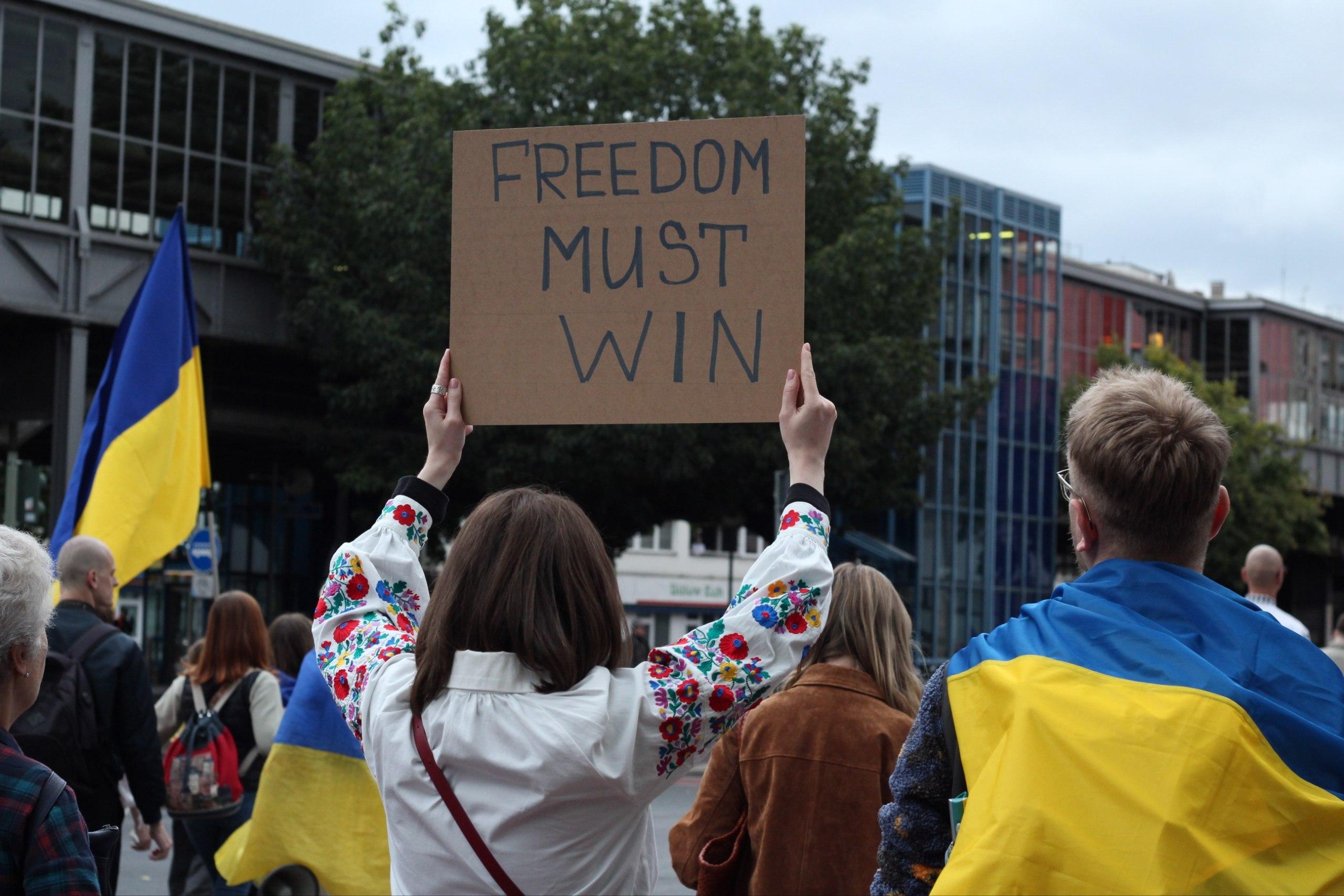
Photo from a Vitsche demonstration in Berlin. Photo: Isabella Hoyer
Their newfound independence did not mark the end of Ukraine’s struggle for self-determination. The decades that followed demonstrated that establishing an independent state was only one part of achieving true autonomy. Ukrainians would be forced to continue to defend their right to decide how that state was governed.
Defending the right to choose
The Orange Revolution took place in late 2004 and early 2005 and was sparked by widespread electoral fraud during the presidential run-off election. The election was won by pro-Russian candidate Viktor Yanukovych however was fraught with doubts over its legitimacy. Viktor Yushchenko, the pro-Western candidate, even suffered dioxin poisoning during the campaign and was with permanent disfiguration to his face.
On 21 November 2004, Yanukovych was declared the winner of the election. His victory came despite widespread evidence of ballot stuffing, voter intimidation and other electoral irregularities, triggering mass peaceful protests. Despite freezing weather, hundreds of thousands of Yushchenko supporters, many wearing orange ribbons, flags and scarves, gathered in Kyiv’s Independence Square to protest the results.
The protests were ultimately successful; the Supreme Court annulled the result and ordered a re-run. Yushchenko won the December 2004 revote with 52% of the vote and took office in January 2005.
The Orange Revolution was a key moment in Ukraine’s post-independence history; it demonstrates the importance of democratic choice and their right to determine their own political future. While questions about Ukraine’s relationship with Russia and the West formed an important part of the wider context, the protests centred on the fundamental right to free and fair elections.
The movement demonstrated that Ukrainian independence was not simply about freedom from Soviet rule, but also about Ukrainians having the freedom to decide for themselves who governs them and what direction their country takes.
The Revolution of dignity.
Ten years later, in 2013–14, Ukraine saw the Revolution of Dignity. The movement came from the Euromaidan protests, which were sparked by Yanukovych’s government suspending preparations for signing an Association Agreement with the EU.
In November 2013, the decision to step back from signing prompted widespread anger among Ukrainian citizens. Many protesters wanted closer relations with Europe however the movement also reflected wider dissatisfaction with corruption and the government’s lack of accountability. The government’s introduction of restrictive anti-protest laws in January 2014 further deepened tensions with protestors.
The protesters gathered in Independence Square, or the Maidan, where thousands of participants camped out. The movement was initially focused on opposition to the government’s decision on the EU agreement but subsequently broadened into demands for democracy, accountability and an end to corruption.
Security forces used increasing violence against protesters resulting in over 100 protesters being killed during the demonstrations. These demonstrators are collectively remembered as the “Heavenly Hundred”. The protests ultimately ended with Yanukovych fleeing Ukraine.
The Revolution of Dignity was another vital moment in Ukraine’s journey towards independence. After gaining independence in 1991 and defending their democratic choice through the Orange Revolution, Ukrainians again demonstrated that independence was not only the existence of Ukraine as a state. It was also about having the freedom to decide what that state should look like, who should govern it and what direction it should take.
When sovereignty was attacked
The Revolution of Dignity and citizen’s exercise of political choice was met with a new and direct challenge to Ukrainian sovereignty.
Following the Revolution of Dignity, Russia occupied Crimea and supported armed separatist groups in eastern Ukraine. The struggle over Ukraine’s independence had further developed; Ukrainians were no longer only fighting to determine their political future, but to defend the independence they had previously chosen.
Russia’s occupation of Crimea and its support for armed conflict in Donbas marked the beginning of a war that would fundamentally change Ukraine’s struggle for independence. For the next eight years, the conflict continued in eastern Ukraine and Crimea remained under Russian occupation.
On 24 February 2022, Russia launched a full-scale invasion of Ukraine.
Full Scale Invasion
The full-scale invasion brought the question of Ukrainian independence into its most direct form. Russia’s invasion was not just an attack on Ukrainian territory. Instead it was a challenge to Ukraine’s sovereignty and to the right of Ukrainians to determine their own political future.
Since February 2022, Ukrainians have continued to defend their homes and country. However, this defence is not confined to the battlefield. There is a further struggle aimed at preserving Ukrainian language, culture, communities and history whilst also maintain the sovereignty of independent Ukraine.
The history of Ukraine’s struggle for independence cannot be separated from its history of repression. From the Ukrainian People’s Republic, through decades of Soviet persecution and cultural suppression and the democratic movements of 2004 and 2013–14, Ukrainians have repeatedly asserted their right to determine their own future. Today, they are forced to continue defending this right.
So what does independence actually mean?
For me, independence has always primarily been a political debate. Ukraine has shown me a different understanding. For Ukrainians, independence is not simply a political question to debate. It is about maintaining the sovereignty and culture that allow them to make that choice at all. It has shown me the reality of having to defend a chosen path of independence, and the need to fight to ensure that independence remains a viable part of Ukraine’s future.
A vital part of Ukrainian independence is the recognition and sovereignty of the state, and they are forced to defend his from Russian invasion every day. For Ukraine, independence is also something even deeper, it is expressing and preserving culture, choosing who governs Ukrainian people, remembering its own history and maintaining a sense of belonging.
Ultimately, Ukrainian independence is about Ukraine determining its own future.
From

Grace Maclean
Intern